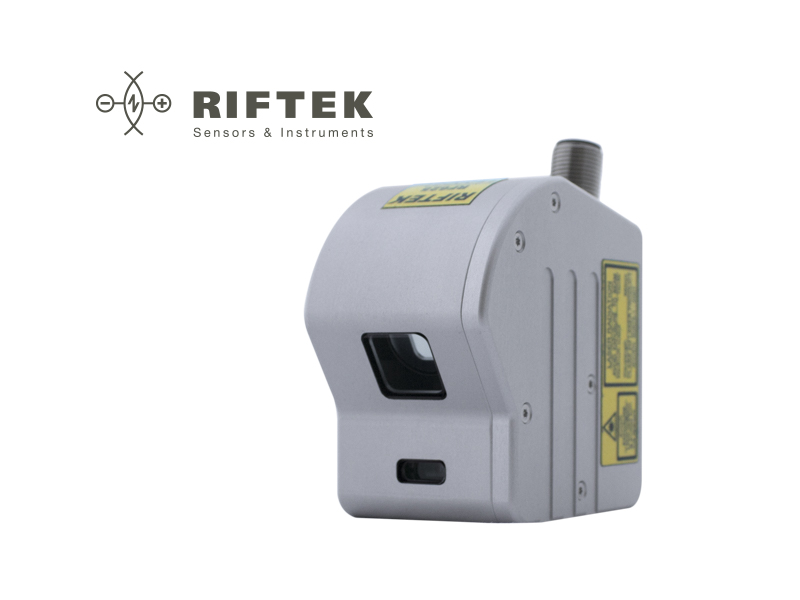


In RF627Smart the analysis, calculations, measurements, tolerance control are carried out directly inside scanner according to the algorithm created by the user. Measurement results can be transmitted via various protocols (Ethernet/IP, Modbus TCP, UDP), as well as to the logic outputs of the scanner in order to control the actuators and notify about product suitability.
In addition, Smart scanners (profilers) contain built-in protocols for interaction with various industrial robots and cobots, allowing the scanners to be integrated into automation systems without the need to purchase additional equipment.
-
RF627Smart — profilers with in-built measurement functions and industry protocols;
RF627BiSmart — dual-camera profilers with in-built measurement functions and industry protocols;
RF628Smart — high speed profilers;
RF629Smart — high speed profilers with increased resolution;
RF6292Smart — high speed profilers with increased resolution and increased "laser line length/range" ratio;
RF627Smart-Weld — profilers for welding robots with in-built functions of weld seam tracking and measurement;
RF627AVIKScanSmart — hand-held profilers for weld seam geometry control.
RF62x SDK Source code — is available here.
RF62x Firmware — is available here.

RF627Smart —


RF627BiSmart—

RF628Smart —

RF629Smart —

RF6292Smart —
2D laser scanner RF62х. Specification
RF62х Basic technical data
| Laser | |
|
660 nm or 405 nm or 450 nm 808 nm Class 2M according to IEC/EN 60825-1:2014 or Class 3B on request |
|
| Interface | |
| Basic | Ethernet / 1000 Mbps |
| Synchronization inputs | RS422, 3 channels |
| Laser on/off hardware input | 1 |
| Outputs | RS422, 1 channel |
| Power supply | 9...30 V or 12...36 V for scanners with Blue laser |
| Power consumption, not more |
RF627Smart - 6 W (without a built-in heater) RF627BiSmart - 11 W RF628Smart - 17 W RF629Smart and RF6292Smart - 17 W |
| Environment resistance | |
| Enclosure rating | IP67 |
| Vibration | 20 g / 10...1000 Hz, 6 hours for each of XYZ axes |
| Shock | 30 g/6 ms |
| Operating ambient temperature, °С |
-20...+40, or -40...+40 for scanners with built-in heater, or -40...+120 for scanners with built-in heater and cooling system |
| Relative humidity | 5-95% (no condensation) |
| Storage temperature, °С | -20...+70 |
| Housing/windows material | aluminum/glass |
RF627Smart. Specification
| Sampling rate, accuracy, resolution | |
| Nominal sampling rate (full working range), not less | 520 profiles/s |
| Maximal sampling rate (ROI mode) | 4200 profiles/s |
| Linearity (measurement error), Z axis | ±0,01% of the range (standard mode)¹ |
| Resolution, X axis | 728 or 1456 points (programmable value) |
| Range | MR, mm | SMR, mm | EMR, mm | Хsmr, mm | Xemr, mm |
| 25/10-8/11 | 10 | 25 | 35 | 8 | 11 |
| 65/25-20/22 | 25 | 65 | 90 | 20 | 22 |
| 75/50-30/41 | 50 | 75 | 125 | 30 | 41 |
| 70/100-48/82 | 100 | 70 | 170 | 48 | 82 |
| 70/150-58/122 | 150 | 70 | 220 | 58 | 122 |
| 95/150-53/106 | 150 | 95 | 245 | 53 | 106 |
| 82/200-60/150 | 200 | 82 | 282 | 60 | 150 |
| 90/250-65/180 | 250 | 90 | 340 | 65 | 180 |
| 180/250-170/278 | 250 | 180 | 430 | 170 | 278 |
| 190/300-160/300 | 300 | 190 | 490 | 160 | 300 |
| 220/300-203/330 | 300 | 220 | 520 | 203 | 330 |
| 260/400-210/400 | 400 | 260 | 660 | 210 | 400 |
| 325/500-268/500 | 500 | 325 | 825 | 268 | 500 |
| 400/600-320/600 | 600 | 400 | 1000 | 320 | 600 |
| 475/700-374/700 | 700 | 475 | 1175 | 374 | 700 |
| 545/800-425/800 | 800 | 545 | 1345 | 425 | 800 |
| 615/900-480/900 | 900 | 615 | 1515 | 480 | 900 |
| 690/1000-535/1000 | 1000 | 690 | 1690 | 535 | 1000 |
| 620/1165-430/1010 | 1165 | 620 | 1785 | 430 | 1010 |
RF627BiSmart. Specification
| Sampling rate, accuracy, resolution | |
| Nominal sampling rate (full working range), not less |
520 profiles/s |
| Maximal sampling rate (ROI mode) |
4200 profiles/s |
| Linearity (measurement error), Z axis |
±0,01% of the range¹ |
| Resolution for combined profile, Х axis | 1456 or 2912 points (programmable value) |
| Range | MR, mm | SMR, mm | EMR, mm | Хsmr, mm | Xemr, mm |
| 27/10-8/11 | 10 | 27 | 37 | 8 | 11 |
| 65/25-20/22 | 25 | 65 | 90 | 20 | 22 |
| 75/50-30/41 | 50 | 75 | 125 | 30 | 41 |
| 70/100-48/82 | 100 | 70 | 170 | 48 | 82 |
| 70/150-58/122 | 150 | 70 | 220 | 58 | 122 |
| 95/150-53/106 | 150 | 95 | 245 | 53 | 106 |
| 82/200-60/150 | 200 | 82 | 282 | 60 | 150 |
RF628Smart. Specification
| Sampling rate, accuracy, resolution | |
| Nominal sampling rate (full working range), not less |
4000 profiles/s |
| Maximal sampling rate (ROI mode) |
16000 profiles/s |
| Linearity (measurement error), Z axis |
±0,01% of the range¹ |
| Resolution, X axis | 640 or 1280 points (programmable value) |
| Range | MR, mm | SMR, mm | EMR, mm | Хsmr, mm | Xemr, mm |
| 65/10-11/12 | 10 | 65 | 75 | 11 | 12 |
| 75/25-20/22 | 25 | 75 | 100 | 20 | 22 |
| 90/50-32/44 | 50 | 90 | 140 | 32 | 44 |
| 125/75-42/58 | 75 | 125 | 200 | 42 | 58 |
| 150/100-50/74 | 100 | 150 | 250 | 50 | 74 |
| 150/150-64/112 | 150 | 150 | 300 | 64 | 112 |
| 210/300-148/276 | 300 | 210 | 510 | 148 | 276 |
| 285/400-198/376 | 400 | 285 | 685 | 198 | 376 |
| 370/500-250/466 | 500 | 370 | 870 | 250 | 466 |
| 450/600-300/556 | 600 | 450 | 1000 | 300 | 556 |
| 530/700-350/650 | 700 | 530 | 1230 | 350 | 650 |
| 610/800-400/744 | 800 | 610 | 1410 | 400 | 744 |
| 685/900-450/836 | 900 | 685 | 1585 | 450 | 836 |
| 765/1000-500/930 | 1000 | 765 | 1765 | 500 | 930 |
RF629Smart. Specification
| Sampling rate, accuracy, resolution | |
| Nominal sampling rate (full working range), not less |
1000 profiles/s |
| Maximal sampling rate (ROI mode) |
16000 profiles/s |
| Linearity (measurement error), Z axis |
±0,01% of the range¹ |
| Resolution, X axis | 1280 or 2560 points (programmable value) |
| Range | MR, mm | SMR, mm | EMR, mm | Хsmr, mm | Xemr, mm |
| 60/25-22/26 | 25 | 60 | 85 | 22 | 26 |
| 60/50-36/50 | 50 | 60 | 110 | 36 | 50 |
| 65/100-56/100 | 100 | 65 | 165 | 56 | 100 |
| 90/150-70/140 | 150 | 90 | 240 | 70 | 140 |
| 110/200-84/178 | 200 | 110 | 310 | 84 | 178 |
| 95/250-100/250 | 250 | 95 | 345 | 100 | 250 |
| 190/300-120/300 | 300 | 190 | 490 | 120 | 300 |
| 145/400-158/400 | 400 | 145 | 545 | 158 | 400 |
| 180/500-198/500 | 500 | 180 | 680 | 198 | 500 |
| 230/600-236/600 | 600 | 230 | 830 | 236 | 600 |
| 265/700-274/700 | 700 | 265 | 965 | 274 | 700 |
| 310/800-314/800 | 800 | 310 | 1110 | 314 | 800 |
| 345/900-352/900 | 900 | 345 | 1245 | 352 | 900 |
| 375/1000-392/1000 | 1000 | 375 | 1375 | 392 | 1000 |
RF6292Smart. Specification
| Sampling rate, accuracy, resolution | |
| Nominal sampling rate (full working range), not less |
4000 profiles/s |
| Maximal sampling rate (ROI mode) |
without ROI |
| Linearity (measurement error), Z axis |
±0,01% of the range ¹ |
| Resolution, X axis | 1280 or 2560 points (programmable value) |
| Range | MR, mm | SMR, mm | EMR, mm | Хsmr, mm | Xemr, mm |
| 70/5-24/24 | 5 | 70 | 80 | 24 | 24 |
| 80/15-40/44 | 15 | 80 | 95 | 40 | 44 |
| 95/25-70/81 | 25 | 95 | 120 | 70 | 81 |
| 135/35-90/105 | 35 | 135 | 170 | 90 | 105 |
| 170/45-110/130 | 45 | 170 | 215 | 110 | 130 |
| 170/75-146/194 | 75 | 170 | 245 | 146 | 194 |
| 220/90-200/256 | 90 | 220 | 310 | 200 | 256 |
| 355/120-302/376 | 120 | 355 | 575 | 302 | 376 |
| 455/170-400/500 | 170 | 455 | 625 | 400 | 500 |
| 550/225-500/624 | 225 | 550 | 775 | 500 | 634 |
Note: ¹ - linearity for height measurement across the entire field of view of the scanner.
Operation of the scanners is based on the principle of optical triangulation.
Radiation of a semiconductor laser is formed by a lens in a line and projected to an object. Radiation scattered from the object is collected by the lens and directed to a two-dimensional CMOS image sensor. The image of object outline thus formed is analyzed by a signal processor, which calculates the distance to the object (Z-coordinate) for each point of the set along the laser line on the object (X-coordinate). Scanners are characterized by base distance (beginning of the range), SMR, for Z-coordinate, measuring range (MR) for Z-coordinate, measuring range for X-coordinate at the beginning of Z (Xsmr) and measuring range for X-coordinate at the end of Z (Xemr).

High precision noncontact measurements:
- Profile


- Dimensions

- Recognition

- Control

RF627Smart - Create the scanner you want.
Analysis, calculations, measurements, tolerance control are carried out inside scanner according to the algorithm created by the user.
RF627Smart scanner. Training video.
Analysis, calculations, measurements, control of dimensions are carried out directly in the scanner according to the algorithm created by the user.
Example of Synchronous work of RF627 Laser scanners with three different wavelength. 3D Laser scanning of the rope, shape and defects control.
Example of Laser scanners asynchronous work. Pipes OD and ovality measurement by RF627-82/200-60/150.
Demonstration stand of RF625 Laser Scanners.
RF62X.(WAVE)-smrZ/MR-Xsmr/Xemr-M(R)-H-AK-EW-AC-lndO
| Symbol | Description |
| X |
7Smart – RF627Smart scanner; 7BiSmart – RF627BiSmart scanner; 8Smart, 9Smart, 92Smart – RF628Smart, RF629Smart and RF6292Smart scanners respectively. |
| (WAVE) | Laser wavelength. 660 nm – no symbol, 405 nm or 450 nm – BLUE, 808 nm – IR. |
| smrZ | Beginning of the measuring range for Z, mm. |
| MR | Measuring range for Z, mm. |
| Xsmr | Measuring range for X-coordinate at the beginning of the measuring range for Z-coordinate, mm. |
| Xemr | Measuring range for X-coordinate at the end of the measuring range for Z-coordinate, mm. |
| М | Cable length, m |
| R | Option, robot-cable. |
| H | Built-in heater. |
| AK | Air knife for windows. |
| EW | Removable protective windows. |
| AC(WC) |
AC - air cooling system; WC - water cooling system. NOTE. The WC option includes the AC option by default. |
| lndO |
Smart scanner version depending on supported protocols. Base - basic version, by default contains smart blocks of profile primitives extraction, smart blocks of their mathematical and statistical processing, smart blocks of data transmission/reception in the form of tcp and udp packets. Ind - Industrial version, contains smart blocks of "Base" package, as well as smart blocks of data transmission/reception via industrial protocols (EthernetIP, ModbusTCP) and smart blocks of interaction with industrial robots. |
Example: RF627BLUE-70/50-30/42-5-Ind – Scanner with a blue laser, smrZ - 70 mm, MR - 50 mm, Xsmr - 30 mm, Xemr - 42 mm, cable length - 5 m, Industrial version.
A 2D laser scanner — also called a laser profile scanner or laser profiler — is a non-contact measurement device that captures the complete cross-sectional profile of an object in a single pass. Instead of measuring a single point, it projects a laser line onto the surface and records how that line deforms across the object's geometry.
The principle is optical triangulation: the laser line reflects off the surface and is captured by a CMOS image sensor at a known angle. A built-in processor calculates the distance to each point along the line, producing a high-resolution 2D profile with X and Z coordinates. When the scanner or object moves, successive profiles stack into a complete 3D surface representation.
RF63x series scanners capture up to 58,000 profiles per second, making them suitable for high-speed inline inspection without slowing production.
A 2D laser profile scanner captures a single cross-sectional slice — measuring height and width along the laser line to deliver data on dimensions, shape, and surface features within that plane.
A 3D scanner builds a full volumetric model by combining multiple 2D profiles as the object or sensor moves, producing a point cloud for complete surface geometry analysis, defect detection, and CAD comparison.
In practice: for pipe diameter, weld bead height, or high-speed profile inspection, a 2D laser scanner is the right tool. For complex 3D geometry — forgings, suspension arms, free-form surfaces — a 3D approach is needed. RF62x and RF63x scanners support both modes depending on system integration.
A 2D laser profile scanner covers a wide range of dimensional and geometric tasks. In a single scan pass it can measure profile shape and contour, width and height, gap and flush, angle and radius, outer diameter and ovality, edge position, weld bead geometry, and flatness of flat components.
RF62x Smart scanners perform these calculations directly inside the scanner according to user-defined algorithms — no external controller or PC required. This makes the system self-contained and straightforward to deploy in automated lines.
Both technologies are based on the same optical triangulation principle, but they serve different measurement tasks.
A laser triangulation sensor measures a single point — it returns the distance from the sensor to one spot on the object surface. This makes it ideal for displacement, position, vibration, and thickness measurements where point-by-point data is sufficient. Riftek RF603 series sensors, for example, cover operating ranges from 2 mm to 1,250 mm with measuring error down to ±1 µm.
A 2D laser scanner projects a full laser line rather than a point, capturing hundreds or thousands of measurement points simultaneously across the object's cross-section. This produces a complete profile in one acquisition — dimensions, shape, and geometry — rather than a single distance value.
The practical difference: use a laser triangulation sensor when you need fast, precise single-point measurement of distance or displacement. Use a 2D laser profile scanner when you need to measure shape, width, contour, or detect profile deviations across the surface.
Sampling rate varies by model and is one of the primary selection criteria depending on your application speed:
- RF627Smart — 520 profiles/s nominal, up to 4,200 profiles/s in ROI mode
- RF627BiSmart — 520 profiles/s nominal, up to 4,200 profiles/s in ROI mode
- RF628Smart — 4,000 profiles/s nominal, up to 16,000 profiles/s in ROI mode
- RF629Smart — 1,000 profiles/s nominal, up to 16,000 profiles/s in ROI mode
- RF6292Smart — 4,000 profiles/s nominal
- RF630 - 3400 profile/s nominal and up to 58000 profiles/s for 1024 resolution in ROI
- RF631 - 1900 profile/s nominal and up to 26000 profiles/s for 2300 resolution in ROI
ROI (Region of Interest) mode restricts the active sensor area to a defined measurement zone, allowing the scanner to operate at maximum speed without processing the full frame. For most inline 2D laser measurement applications — dimensional control, profile inspection, sorting — even the base sampling rate of RF627Smart is sufficient. High-speed models RF628Smart and RF629Smart are designed for fast-moving production lines where profile capture must keep pace with conveyor or extrusion speed.
RF62x and RF63x scanners are available with three laser wavelengths, and the right choice depends on the material and surface condition of the object being measured.
660 nm (red) is the standard option and works well for the majority of industrial materials — metals, plastics, machined surfaces, and painted parts. It offers a good balance of power, resolution, and cost.
405 nm or 450 nm (blue) is recommended for surfaces where red laser performance is degraded: red-hot or incandescent metals, organic materials, rubber, wood, and some translucent plastics. The shorter wavelength does not penetrate into semi-transparent surfaces, which eliminates subsurface scattering and produces a sharper, more stable profile. If you are measuring hot-rolled steel, biological tissue, or food products, blue laser is the better choice.
808 nm (IR) is used for surfaces that absorb visible light or where a laser beam invisible to the human eye is required for safety or process reasons. It is less common but useful in specific material handling and sorting applications.
When in doubt, contact Riftek engineers — the right wavelength is determined by material reflectivity and surface temperature, not by measurement range or accuracy requirements.
Yes, and this is one of the key advantages of the RF62xSmart series. The scanner contains built-in communication protocols for direct interaction with industrial robots and cobots, eliminating the need for additional interface hardware or controllers between the scanner and the robot system.
For CNC integration, the scanner transmits measurement data via Ethernet, Modbus TCP, Ethernet/IP, or UDP — standard protocols supported by most CNC controllers and PLCs. Measurement results, tolerance decisions, and go/no-go outputs can be fed directly into the machine control loop for in-process compensation or post-process sorting.
The RF62xSmart is used as a 2D scanner for CNC applications including weld seam tracking, part profile verification, and in-line dimensional control on machining and assembly lines. The dedicated RF627Smart-Weld variant is specifically configured for welding robot integration, with built-in functions for seam tracking and weld bead measurement.
RF627Smart scanners transmit data via the following interfaces:
- Ethernet / 1000 Mbps — base interface for all models
- Ethernet/IP and Modbus TCP — available in the Industrial (Ind) version, enabling direct integration with PLCs and industrial automation systems
- UDP — for high-speed data streaming to external processing systems
- RS422 — synchronization inputs (3 channels) and one output channel for encoder or trigger synchronization
- Logic outputs — for direct actuator control and pass/fail signaling without external processing
The Base version includes TCP and UDP data transmission along with smart profile processing blocks. The Ind version adds Ethernet/IP and Modbus TCP support, plus dedicated smart blocks for interaction with industrial robots.
For most factory automation and CNC laser measuring system applications, the Ind version is the appropriate choice. If you are building a custom integration using the SDK, the Base version provides sufficient interface capability.
In-scanner processing means that measurement calculations, tolerance evaluation, and output logic run directly inside the RF62xSmart — not on an external PC or controller.
In a conventional setup, the scanner sends raw profile data to an external computer for processing, which adds latency, requires additional hardware, and creates a dependency on external software for every measurement decision.
With RF62xSmart, the user programs measurement algorithms directly into the scanner. It then executes profile analysis, applies tolerances, and outputs pass/fail decisions or measurement values autonomously. The result is simpler system architecture, lower latency, reduced hardware cost, and easier deployment in distributed automation environments.
The primary selection parameters are measurement range, sampling rate, and X-axis resolution. Here is a brief orientation across the series:
RF627Smart is the most versatile model — wide range of Z measurement distances from 10 mm to 1,165 mm, 728 or 1,456 points per profile, built-in smart processing and industrial protocols. The right starting point for most standard 2D profile measurement system applications.
RF627BiSmart uses a dual-camera configuration, which doubles the effective X resolution (up to 2,912 points) and improves performance on surfaces with complex geometry or sharp edges. Suited for applications requiring higher lateral resolution within the same range as RF627Smart.
RF628Smart is optimized for high speed — up to 16,000 profiles/s — with a slightly lower X resolution (640 or 1,280 points). The right choice when production line speed is the primary constraint.
RF629Smart combines high speed (up to 16,000 profiles/s) with increased resolution (1,280 or 2,560 points), making it suitable for fast-moving objects where profile detail matters.
RF6292Smart is designed for applications requiring a large X field of view relative to the Z range — useful when the laser line must cover a wide surface at a relatively short standoff distance.
RF630 combines high speed, up to 58000 Hz and high resolution (2048 points)
RF631 combines high speed, up to 26000 Hz, very high resolution (4608 points) and large ratio (<2.5…4) for X/Z ranges
If the standard models do not match your geometry, Riftek engineers will help configure the right range, wavelength, and options for your specific measurement task.
RF62x scanners are rated IP67, meaning they are fully protected against dust ingress and can withstand temporary immersion in water. The housing is machined aluminum with glass optical windows, designed for long-term operation in industrial environments without special enclosures.
Additional environmental specifications:
- Vibration resistance: 20 g / 10–1,000 Hz, tested across all three axes
- Shock resistance: 30 g / 6 ms
- Operating temperature: -20°C to +40°C as standard; -40°C to +40°C with built-in heater option; -40°C to +120°C with combined heater and cooling system
- Humidity: 5–95%, non-condensing
The extended temperature options make RF62x scanners suitable for outdoor installations, foundry environments, and applications near heat sources. An air knife accessory is available for window protection in dusty or contaminated environments. For most standard factory and workshop conditions, the base IP67 rating and standard temperature range are sufficient.
Yes. Riftek provides an open SDK for the RF62x and RF63x series, available with full documentation and source code. The SDK enables developers and system integrators to build custom measurement applications, implement proprietary data processing pipelines, and integrate the scanner into specialized software environments beyond what the standard industrial protocols support.
The SDK covers scanner configuration, profile data acquisition, synchronization, and output control. It is suitable for C/C++ and other environments commonly used in industrial automation and machine vision development.
Documentation, source code, and firmware updates are available directly on the Riftek website. For integration projects requiring application engineering support, Riftek technical specialists can assist with SDK implementation and system-level configuration.