


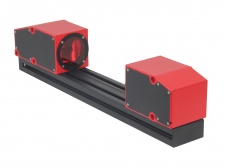
An optical micrometer is used for high-speed, non-contact measurement of objects where traditional mechanical gauges would fail or slow down production. The technology works by projecting a precise beam of light toward a sensor. When an object—such as a wire, pipe, or rod—passes through this beam, it casts a shadow. The system measures the edges of this shadow with incredible accuracy to determine the diameter, position, or width of the object.
This non-contact approach is the gold standard for modern manufacturing. Because a laser micrometer never touches the product, it can measure soft, fragile, or red-hot materials without deforming them or causing surface damage. For any facility moving toward automation, a high precision optical micrometer is the primary tool for ensuring every millimeter of product meets the required specifications.
Choosing Between Linear and Profile Measurement
While all optical micrometers use the shadow principle, the choice between a 1D and 2D system depends on how much information you need regarding the shape of your product.
- Linear Measurement (1D). This is the most efficient solution for tracking a single dimension, such as the thickness of a sheet or the diameter of a steady wire. It is perfect for simple "pass/fail" checks on a high-speed production line.
- Profile Measurement (2D). A 2d optical micrometer uses two beams to look at the object from different angles simultaneously. This 2 axis laser micrometer is necessary if you need to detect ovality or if the product tends to vibrate and move within the measurement area.
- Full Geometric Analysis With a 2d micrometer, the system can calculate the exact center-point and shape of the object. This data is often visualized in a micrometer 2d diagram to help operators understand exactly how the product is behaving during extrusion or assembly.
High-Impact Solutions for Production and Quality Control
The use of optical micrometers and laser micrometers translates directly into material savings and higher product reliability across many industrial sectors.
- Optimizing Extrusion Lines. A laser micrometer extrusion setup provides real-time data to your machinery. If the diameter drifts, the system can automatically adjust the line speed, significantly reducing scrap and raw material waste.
- Integrity of Industrial Piping By using a laser micrometer tube wall thickness measurement configuration, manufacturers can ensure that pipes are perfectly round and centered, which is vital for high-pressure safety.
- Precision in High-Speed Production Whether it is copper wire or fiber optics, these sensors track diameters at extreme speeds, catching defects that would be invisible to the human eye or slower mechanical tools.
- Gap and Edge Monitoring Beyond just diameters, these tools are excellent for measuring the gaps between components or ensuring that the edge of a moving web is perfectly aligned.
Technical Performance and Integration
A modern optical micrometer is an intelligent node that becomes part of a facility's digital ecosystem. High-frequency measurements (up to 10,000 Hz) allow these sensors to monitor processes in real-time, providing an instantaneous response to any deviations from set parameters. Riftek equipment is engineered for diverse industrial integration scenarios.
- Integration into Production Lines Sensors are easily installed on extrusion lines or wire-drawing machines, where they work in tandem with controllers to automatically adjust feed speeds or temperatures.
- Operation in CNC Machines A compact laser micrometer can be integrated directly into the work zone of a CNC machine to automatically check part dimensions immediately after processing, eliminating human error in quality control.
- Communication with Industrial Robots Low response times enable micrometer data to be used for the dynamic positioning of robots and automated manipulators.
- Support for Standard Interfaces Built-in Ethernet and RS232/485 ports, along with support for Modbus or EtherNet/IP protocols, ensure simple data transfer to existing PLC systems or high-level ERP networks.
- Comprehensive Measurement Complexes Multiple devices can be networked to monitor various parameters simultaneously, such as differential dimensions or the construction of a complex micrometer 2d diagram for an entire assembly.
The Riftek Advantage in Precision Metrology
Riftek systems are built to be more than just sensors; they are integrated solutions designed to survive the realities of a factory floor while maintaining laboratory-level accuracy.
- Distortion-Free Imaging Our high-precision models use telecentric optics to ensure the measurement stays accurate even if the object moves closer to or further from the sensor.
- High-Frequency Stability With sampling rates reaching up to 10,000 Hz, our sensors filter out factory vibrations to provide a clean and reliable data stream.
- Smart Logic Integration Riftek controllers allow you to build custom measurement algorithms using simple visual blocks, making it easy to adapt to complex parts without advanced programming skills.
- Industrial Durability Every optical micrometer is housed in a rugged, IP67-rated enclosure to protect the sensitive optics from the oil, dust, and heat common in heavy manufacturing.
- Plug-and-Play Connectivity Standard support for Ethernet, Modbus, and analog signals ensures the system connects seamlessly to your existing PLC or control network.